HCM is lifelong and life-threatening
Hypertrophic cardiomyopathy (HCM) is the most common heart disease in cats, affecting about 1 in 7.1,2 HCM causes the heart muscle to become abnormally thick, making it harder for the heart to pump blood effectively.
This can lead to things like:
- Rapid heartbeat or irregular heart rhythm (beating too fast or slow)
- Congestive heart failure, or fluid buildup in the chest
- Blood clots throughout the body that block blood flow, causing pain and paralysis
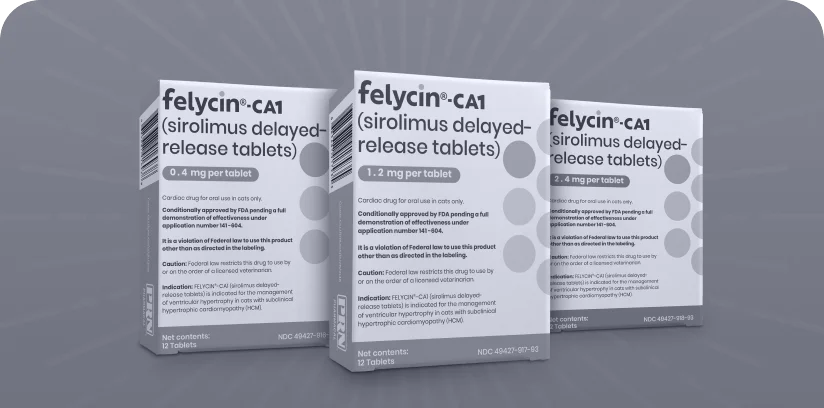
Unfortunately, cats that develop congestive heart failure or blood clots are unlikely to survive to 1 year after diagnosis.3 This makes catching and managing HCM early all the more important. With the introduction of Felycin®-CA1 (sirolimus delayed-release tablets), it’s possible to manage the disease and make a difference in your cat’s heart health.
Understanding how heart cells work
Scientists researching rapamycin, also known as sirolimus, discovered a previously unknown network of signals between cells within the body. They learned that this communication system tells cells when to grow, when to make repairs, and how to respond to different situations.
It’s a complex system that manages important processes like:
- Cell growth and repair
- Building proteins the heart needs
- Managing energy
- Responding to stress
This same communication system is found throughout your cat's body and plays an important role in the liver, muscles, brain, and other organs. When it doesn't work properly, it can contribute to heart disease in cats.
Sirolimus gives cats a fighting chance
Sirolimus, also known as rapamycin, has an interesting backstory. Originally discovered on Rapa Nui (Easter Island) and first used in human medicine to prevent organ transplant rejection, doctors noticed something unexpected: kidney transplant patients taking this medication also showed reduced heart wall thickness.4
This observation led scientists to investigate whether sirolimus could help cats with HCM.
- The Problem: In cats with HCM, cellular signals become overactive, sending too many messages for heart muscle cells to grow and multiply. This leads to the characteristic thickening of the heart walls.
- The Solution: Research suggests sirolimus turns down these overactive signals, which may help prevent and even reverse the harmful thickening of heart muscle.
Research in laboratory studies and human patients has shown that sirolimus can actually reverse problematic heart muscle thickening.
The proof is in the RAPACAT study5
To receive FDA conditional approval, all medications must undergo clinical trials to make sure they are safe and show a reasonable expectation of effectiveness. For Felcyin-CA1, scientists conducted the RAPACAT study, a clinical trial specifically designed to test sirolimus in cats with subclinical HCM (cats who have the disease but aren't showing symptoms yet).
The results were encouraging:
- Cats treated with Felycin-CA1 showed a reduction in heart wall thickness compared to cats given a placebo.
- The medication was well-tolerated by the cats in the study.
- The treatment appeared to prevent or delay the progression of heart muscle thickening.
Felycin-CA1 is currently conditionally approved by the FDA, meaning ongoing studies continue to evaluate its long-term effects and benefits.
Long live cats with HCM
For cats with HCM, sirolimus offers a new way to address the disease. Instead of waiting for symptoms to develop and then treating complications, this medication may help:
- Slow down or prevent further heart muscle thickening
- Delay the onset of heart failure symptoms
- Make a difference for your cat’s heart health
Felycin-CA1 is given as a once-weekly dose to help make it easier for you to give your cat the medication and help reduce the risk of side effects. While HCM remains a serious condition, treatments like Felycin-CA1 offer hope that cats diagnosed with this disease can experience improved heart health.
For the first time, we have a tool that may help address what's actually causing the disease rather than just managing the symptoms. Learn more about Felycin-CA1.
If you think your cat might benefit from this medication, talk to your veterinarian about whether Felycin-CA1 could be right for them.
Frequently Asked Questions
References
1 Fuentes VL, Abbott J, Chetboul V, et al. ACVIM consensus statement guidelines for the classification, diagnosis, and management of cardiomyopathies in cats. JVIM 2020;34:1062-1077.
2 Kittleson MD, Cote E. The feline cardiomyopathies: Hypertrophic cardiomyopathy. JFMS 2021;23:1028-1051.
3 Fox PR, Keene BW, Lamb K, et al. International collaborative study to assess cardiovascular risk and evaluate long-term health in cats with preclinical hypertrophic cardiomyopathy and apparently healthy cats: The REVEAL Study. JVIM 2018;32:930-943.
4 “Rapamycin’s secrets unearthed.” Chemical & Engineering News. 18 July 2026.
5 Kaplan JL, Rivas VN, Walker AL, et al. Delayed-release rapamycin halts progression of left ventricular hypertrophy in subclinical feline hypertrophic cardiomyopathy: results of the RAPACAT trial. JAVMA 2023;261(11):1628-1637.