Fight HCM with
Felycin®-CA1

(sirolimus delayed-release tablets)

Felycin-CA1 is the first and only medication conditionally approved by the FDA for for the management of ventricular hypertrophy in cats with subclinical hypertrophic cardiomyopathy (HCM).

Now you can offer early intervention to your feline patients with subclinical HCM.

We studied it so you can prescribe it with confidence

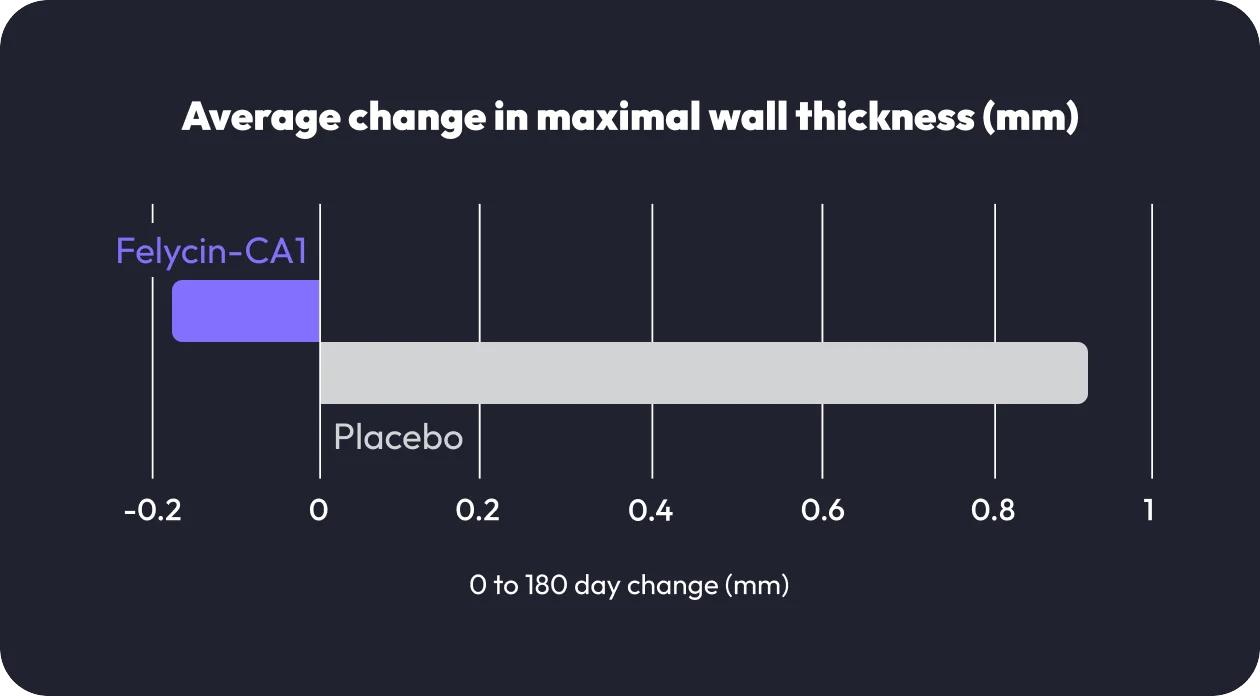
In the RAPACAT study, thirty-six cats with subclinical HCM were administered Felycin-CA1 or a placebo. Cats treated with Felycin-CA1 had a significantly lower left ventricular maximal wall thickness, with an average reduction of 0.17 mm in comparison to 0.94 mm increase for cats receiving placebo.1

The drug also underwent extensive safety studies, and Felcyin-CA1’s once-weekly dosing regimen demonstrated a favorable safety profile.
Felycin-CA1’s mode of action

What veterinarians are saying about Felycin-CA1

Ready to prescribe Felycin-CA1?

Join the fight against HCM. To order Felycin-CA1, contact your local representative or authorized distributor.

Tools and Resources

Felycin-CA1 Detailer

Educate your team about subclinical HCM and Felycin-CA1.

Felycin-CA1 Pet Owner Brochure

Teach your clients about the signs of subclinical HCM and how Felycin-CA1 can help.

Felycin-CA1 Social Media Assets

Share these social media assets on your veterinary pages to spark conversations, raise awareness, and keep your clients informed.

If you’re not diagnosing HCM in 1 of every 7 cats you see, you may be missing a chance to intervene.

Your Experience Could Shape the Future of Feline Care

Have you treated a cat with Felycin-CA1? Share your success story and help other clinics see the difference early intervention can make.

Felycin-CA1 FAQ

Can Felycin-CA1 be prescribed without an echocardiogram?

An echocardiogram is the gold standard for diagnosing HCM, and it is strongly recommended to conduct one prior to initiating therapy. While the final decision rests with the prescribing clinician and the pet owner, treatment may occasionally be started without an echocardiogram if both parties elect to proceed. In all cases, it is important to rule out other potential causes of secondary myocardial hypertrophy, including hypertension, hyperthyroidism, and dehydration. Baseline bloodwork is also recommended, as normal liver values should be documented before starting therapy with Felycin-CA1. Felycin-CA1 has fully satisfied all FDA safety requirements, and its use is supported by a robust safety profile.

A recheck schedule will be up to the discretion of the managing clinician. Typically, echocardiograms are repeated every 6-12 months. However, every case is different, and this may depend on a patient’s severity of structural disease at the time of diagnosis.

Is there anything on a recheck echocardiogram that would indicate Felycin-CA1 should be discontinued?

If a cardiomyopathy other than HCM is diagnosed through an echocardiogram, then Felycin-CA1 should be discontinued. Otherwise, Felycin-CA1 is intended to be a lifelong medication for the management of subclinical feline HCM.

Can Felycin-CA1 be given to manage late-stage (clinical) HCM?

The effectiveness of Felycin-CA1 for late-stage (clinical) HCM has not been evaluated and is therefore not recommended.

What drug classification is Felycin-CA1?

The active ingredient in Felycin-CA1 is sirolimus, which is a macrolide.

What is the shelf life of Felycin-CA1?

The shelf life for Felycin-CA1 is 2 years.

Where is Felycin-CA1 metabolized?

The active pharmaceutical ingredient of Felycin-CA1, sirolimus, is absorbed into the blood stream from the small intestines and then metabolized at the level of the hepatocytes in the liver. For this reason, it is recommended to continue to monitor the liver function of patients on Felycin-CA1 over the course of treatment.

If a cat requires two tablets per dose, can administration be staggered?

It is best to give both tablets together to ensure consistent pharmacokinetics/absorption and avoid sub-optimal doses. However, the difference of an hour or two may be better than unsuccessful oral administration. Keep in mind that two tablets will fit together in a pet piller.

What is the best course of action if a dose is missed with Felycin-CA1?

If a dose is missed, advise clients to wait and administer the missed dose until the following week on the normal day and time to keep treatment consistency.

Besides the heart, does any other muscle loss occur when treating a cat with Felycin-CA1?

Felycin-CA1 aims to correct for maladaptive hypertrophy. Its dosing frequency allows for normal mTOR activity within the dosing interval, supporting necessary anabolic functions. For this reason, there is no reason to anticipate effects on healthy muscle.

If giving Felycin-CA1 long-term, is it possible that the left ventricular (LV) wall thickness will reduce too much?

Felycin-CA1 works by normalizing maladaptive processes that contribute to hypertrophy. This pharmacodynamic effect does not support the notion that the LV wall would reduce beyond a physiologically normal range.

If progression isn’t inevitable in subclinical HCM, why intervene?

Not every cat with stage B1 hypertrophic cardiomyopathy will progress to heart failure — and it’s important to be honest about that. However, we also know that once cats develop heart failure or thromboembolic disease, outcomes are poor. That’s why so much effort has gone into identifying which cats are at higher risk for progression.

Most cats with stage B2 disease are at meaningful risk and deserve the opportunity for treatment. And for some stage B1 cats with higher-risk features, early management may also be appropriate. The goal isn’t to treat every cat — it’s to identify the cats most likely to progress and intervene before they experience a devastating outcome.

References
1 Fuentes VL, Abbott J, Chetboul V, et al. ACVIM consensus statement guidelines for the classification, diagnosis, and management of cardiomyopathies in cats. JVIM 2020;34:1062-1077.
2 Kittleson MD, Cote E. The feline cardiomyopathies: Hypertrophic cardiomyopathy. JFMS 2021;23:1028-1051.